Oral Food Challenge Tests for Children
An Oral Food Challenge Test is a gold-standard procedure to accurately diagnose food allergies, helping to confirm or rule out suspected allergens. An Oral Food Challenge Test (OFC) is a medically supervised procedure used to determine whether a child can safely consume a specific food without an allergic reaction. The test is typically conducted in a hospital setting under the guidance of an allergist, ensuring immediate medical care in case of a reaction. In this section deals with how these tests are done, their importance, and what to expect during the procedure. Facilities for conducting an Oral Food Challenge Test are available at BLK MAX Hospital.
Why is an Oral Food Challenge Test Necessary?Possible reasons and triggers
Food allergy diagnoses are often based on symptoms, skin prick tests, or blood tests measuring specific IgE levels. However, these methods can sometimes yield false positives or negatives. The Oral Food Challenge Test provides definitive results by testing the child’s actual response to the food in question. It is particularly helpful to:
- Confirm a suspected food allergy.
- Determine if a child has outgrown a known allergy and can tolerate the particular food.
- Differentiate between an allergy and food intolerance.
How is an Oral Food Challenge Test Conducted?Tests and evaluation methods
1. Preparation
- The child’s medical history is reviewed to ensure the test is safe.
- Parents are instructed to stop antihistamines or certain medications before the test.
2. Test Procedure
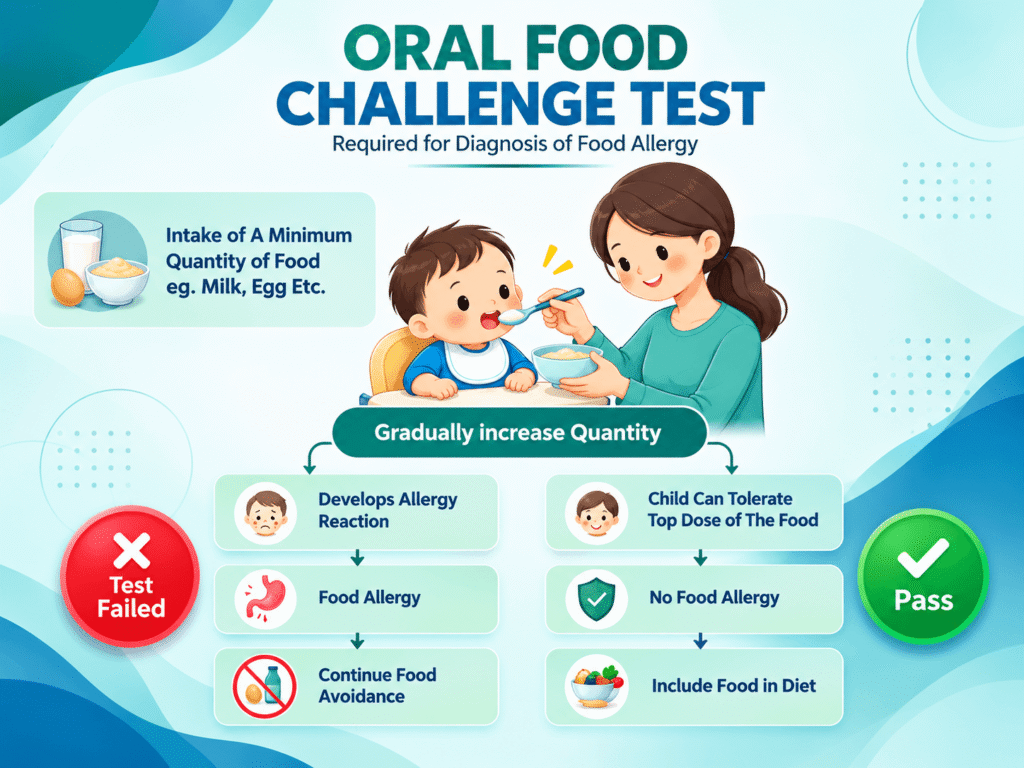
- The food in question is given in gradually increasing amounts, starting with a tiny dose.
- Gradually bigger doses (usually every 20 minutes) are given, until a reaction occurs or the ‘top dose’ is eaten without any allergic reaction. The ‘top dose’ is a normal portion for your child’s age.
- The child is closely monitored for any allergic reactions, such as hives, swelling, or respiratory symptoms.
- The test typically lasts 3-6 hours, depending on the food and the child’s response.
3. Post-Test Monitoring
- After the final dose, the child is observed for an additional period to ensure no delayed reactions occur.
- Detailed instructions are provided for continued monitoring at home.
Oral Food Challenge Tests ResultsTests and evaluation methods
An oral food challenge test could be successful or unsuccessful. It would confirm whether your child has a food allergy or not.
- Successful or Passed Challenge: No reaction during the test; food can be introduced into diet
- Unsuccessful or Failed Challenge: Reaction at the challenge, need to continue to avoid that food
Safety of Oral Food Challenge TestsTests and evaluation methods
Oral Food Challenge Tests are considered safe when conducted in a controlled clinical environment. Emergency medications, including epinephrine, are readily available to manage severe allergic reactions (anaphylaxis). The benefits of accurate diagnosis far outweigh the risks, especially when conducted by trained specialists.
Benefits of Oral Food Challenge TestsTests and evaluation methods
- Accurate DiagnosisReduces unnecessary dietary restrictions and allows children to enjoy a broader range of foods if an allergy is ruled out.
- Guided ManagementProvides clarity on which foods to avoid and helps parents plan safe meals.
The Oral Food Challenge Test is a vital diagnostic tool for confirming food allergies and guiding effective management. By providing accurate results, it empowers families to make informed dietary choices, improving the child’s health and quality of life. If you suspect your child has a food allergy, consult with a specialist to discuss whether an Oral Food Challenge Test is appropriate for them.
Conclusion
1. What is the difference between a food allergy and food intolerance?
A food allergy involves the immune system and can cause severe reactions, while food intolerance typically leads to digestive discomfort without immune involvement.
2. Are Oral Food Challenge Tests safe for all children?Tests and evaluation methods
Yes, when performed under medical supervision, they are safe. However, children with a history of severe anaphylaxis may require additional precautions.
3. How should I prepare my child for an Oral Food Challenge Test?Tests and evaluation methods
Follow your doctor’s instructions, which may include stopping antihistamines and ensuring your child is healthy on the test day.
4. What happens if my child has a reaction during the test?Tests and evaluation methods
Our pediatric allergy team is equipped to manage allergic reactions promptly with medications like antihistamines or epinephrine.
5. Can a child outgrow a food allergy?
Yes, many children outgrow allergies to foods like milk, eggs, and soy. The Oral Food Challenge Test is a key tool in determining this.