On this page 10 sections
- What Are Laryngeal Foreign Bodies?
- Clinical Presentation of Laryngeal Foreign Bodies
- How Is the Diagnosis Made?
- Role of Bronchoscopy in Management
- How Is the Foreign Body Removed?
- Post-Procedure Care and Recovery
- Why Early Detection Is Crucial
- Prevention Tips for Parents
- Conclusion
- Frequently Asked Questions
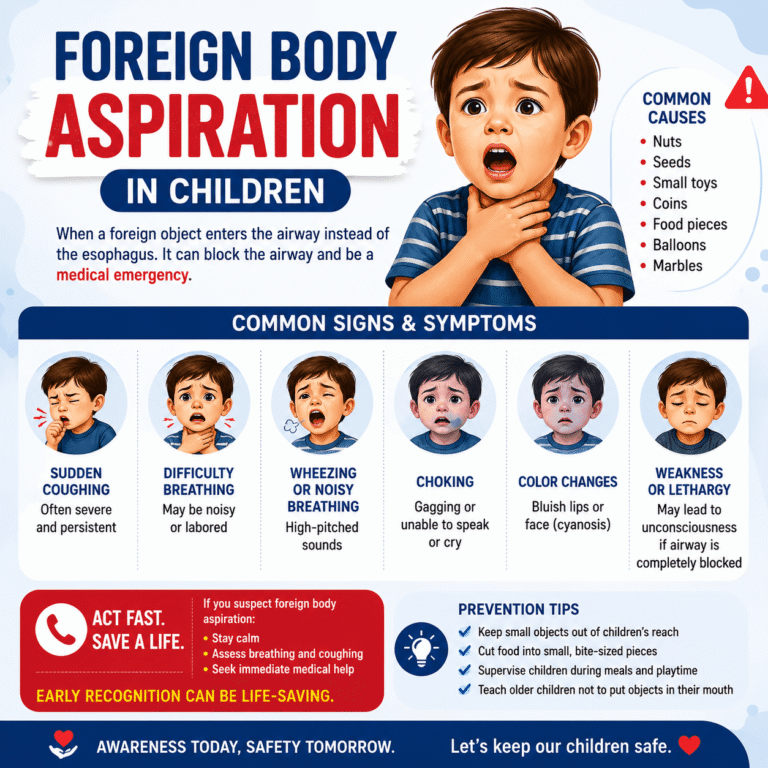
Airway foreign bodies in children are a common pediatric emergency and can be life-threatening if not recognized and treated promptly. Among these, laryngeal foreign bodies are particularly dangerous because they directly obstruct the upper airway, leading to sudden breathing difficulty. Early recognition of symptoms and timely removal using bronchoscopy can be lifesaving.
What Are Laryngeal Foreign Bodies?
Laryngeal foreign bodies are objects that become lodged in the larynx (voice box). This area is narrow and highly sensitive, making even small objects capable of causing significant airway obstruction.
Commonly aspirated objects include:
- Nuts and seeds (peanuts, chana, popcorn)
- Small toys or toy parts
- Coins
- Buttons or beads
- Food particles
Young children are especially vulnerable because of immature chewing, poor airway protective reflexes, and a tendency to put objects in their mouth.
Clinical Presentation of Laryngeal Foreign Bodies
The symptoms of airway foreign bodies in children depend on the size, shape, and position of the object, but laryngeal foreign bodies usually present acutely and dramatically.
Common Symptoms
- Sudden onset of choking
- Severe coughing episodes
- Noisy breathing (stridor)
- Hoarse or absent voice
- Difficulty in breathing
- Cyanosis (bluish discoloration of lips)
- Panic or restlessness in the child
Red Flag Signs
- 🚨 Inability to speak or cry
- 🚨 Severe respiratory distress
- 🚨 Drooling with difficulty swallowing
- 🚨 Sudden collapse or loss of consciousness
These signs indicate critical airway obstruction and require immediate medical attention.
How Is the Diagnosis Made?
Diagnosis is largely clinical, based on:
- A clear history of choking or sudden coughing
- Characteristic respiratory symptoms
Investigations may include:
- Neck and chest X-rays (may show radio-opaque objects or indirect signs)
- Flexible airway assessment in selected cases
However, a normal X-ray does not rule out an airway foreign body.
Role of Bronchoscopy in Management
Bronchoscopy is the gold standard for diagnosis and removal of airway foreign bodies in children.
How Bronchoscopy Helps
- Direct visualization of the airway
- Accurate localization of the foreign body
- Safe removal under controlled conditions
Types of Bronchoscopy
Flexible bronchoscopy: Preferred method in children for diagnosis and extraction of foreign bodies. Various tools are available for extraction such as baskets, rat tooth forceps, and cryoprobes.
Rigid bronchoscopy: May be required occasionally for deeply impacted foreign bodies.
How Is the Foreign Body Removed?
The procedure is performed:
- Under sedation or anesthesia
- By an experienced pediatric pulmonologist
- Using specialized tools such as rat tooth forceps, baskets, or cryoprobes
Steps Involved
- The child is stabilized and given anesthesia
- The bronchoscope is introduced through the mouth
- The foreign body is visualized
- The object is carefully grasped and removed
- The airway is re-examined for injury or residual fragments
Most children recover rapidly after successful removal.
Post-Procedure Care and Recovery
After bronchoscopy:
- The child is monitored for breathing difficulty
- Mild cough or hoarseness may occur temporarily
- Antibiotics or steroids may be prescribed if airway inflammation is present
With timely intervention, outcomes are excellent.
Why Early Detection Is Crucial
Delayed diagnosis of airway foreign bodies in children can lead to:
- Persistent cough or wheezing
- Recurrent pneumonia
- Airway injury or scarring
- Life-threatening complications
Any child with sudden unexplained breathing symptoms should be evaluated urgently.
Prevention Tips for Parents
- Avoid giving nuts and small hard foods to young children
- Supervise meals closely
- Keep small objects out of reach
- Avoid playing or running while eating
Conclusion
The Cough Assist device is a valuable tool in the management of respiratory issues in children with neuromuscular problems. By helping these children clear mucus more effectively, it reduces the risk of infections, improves lung function, and enhances their overall quality of life. If your child suffers from a neuromuscular problem that affects their ability to cough, consult a pediatric pulmonologist to explore the possibility of incorporating a Cough Assist device into their care plan.
Frequently Asked Questions (FAQs)
Frequently Asked Questions
1. What are the most common airway foreign bodies in children?
Food items like peanuts, seeds, and small toy parts are the most common airway foreign bodies in children.
2. Can airway foreign bodies be missed on X-ray?
Yes. Many foreign bodies are not visible on X-ray. A normal X-ray does not rule out aspiration.
3. Is bronchoscopy safe in children?
Yes. When performed by trained specialists, bronchoscopy is a safe and highly effective procedure.
4. How long does recovery take after foreign body removal?
Most children recover within 24–48 hours and can resume normal activities soon.
5. When should parents suspect an airway foreign body?
Sudden choking, coughing, noisy breathing, or voice change-especially after eating or playing—should raise suspicion.
Related conditions & services
Medical Advice & Clinical Disclaimer
The educational medical guidance provided in this guide is for informational purposes only. It should not be used as a substitute for direct pediatric consultation, physical diagnosis, or clinical prescription. For individualized medical assessment of your child, schedule an appointment with Dr. Ankit Parakh.