On this page 8 sections
- When is a Sweat Chloride Test recommended?
- How is a Sweat Chloride Test performed?
- Do we need any special preparation before a Sweat Chloride Test ?
- How much time does it take for a Sweat Chloride Test?
- At what age a Sweat Chloride Test can be done?
- When are the results of a Sweat Chloride Test available?
- Is the Sweat Chloride Test painful?
- What are the chloride levels which suggest Cystic Fibrosis?
Sweat Chloride Test or a Sweat Test is done for the diagnosis of Cystic Fibrosis in children. In sweat chloride test the sweat of the baby is collected first and then the concentration of chloride is analyzed in the sweat sample. The details of sweat chloride test is described here.
When is a Sweat Chloride Test recommended?
Sweat Chloride Test is recommended in babies showing signs and symptoms of cystic fibrosis. The signs and symptoms suggestive of cystic fibrosis in children are recurrent wet cough or a productive cough with sputum or phlegm, repeated lung infections, poor weight gain in babies, frequent episodes of diarrhea and bulky/greesy stools.

How is a Sweat Chloride Test performed?
Sweat Chloride Test requires the collection of sweat of the baby.
Let’s us understand how a Sweat Chloride Test is performed. Sweat Chloride Test has two steps:
Step 1: involves collection of sweat
Step 2: Analysis of the sweat to obtain the sweat chloride levels.
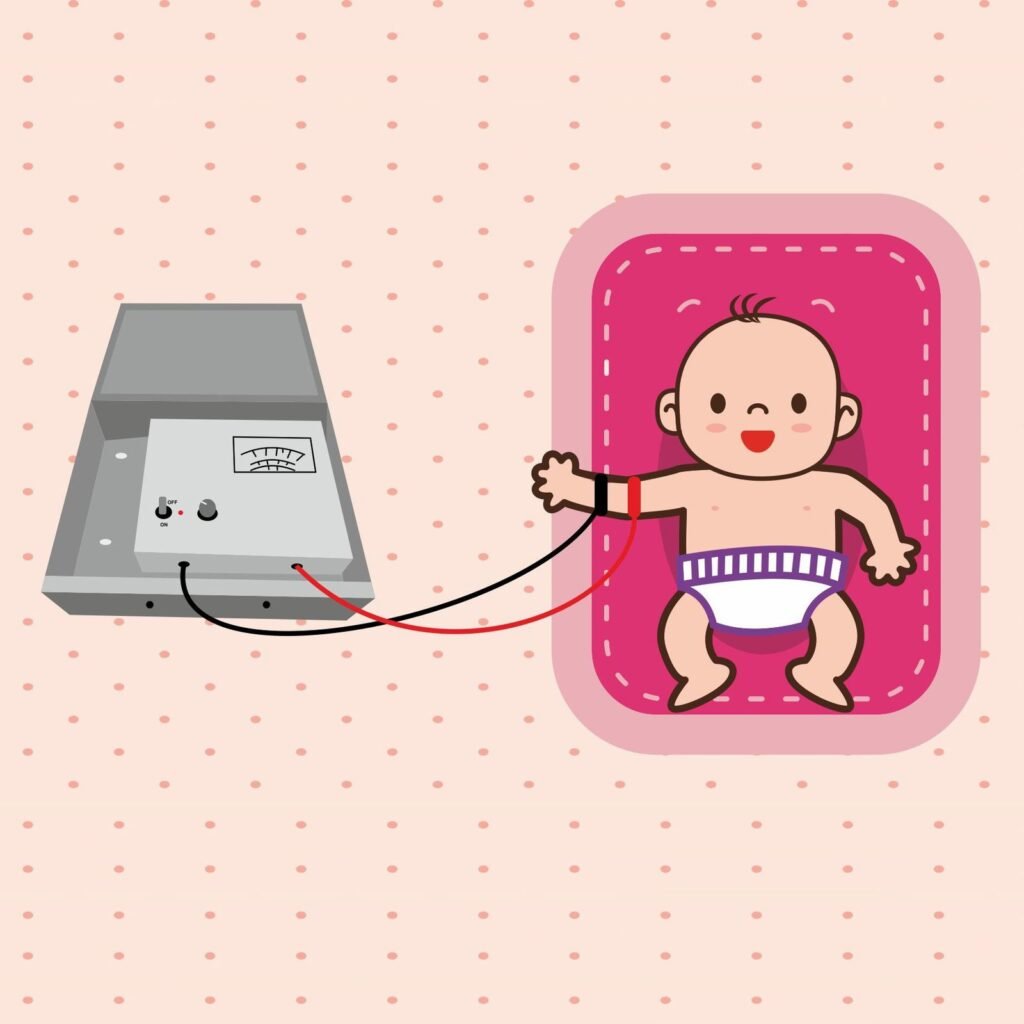
For sweat collection a method known as Quantitative Pilocarpine Iontophoresis is performed using the Gibson and Cooke’s method.
Step 1:
In this step an area of skin on the forearm of the child is cleaned and dried. Thereafter, two electrodes are attached with straps to the cleaned area on the forearm as shown in the photograph. One of these electrodes contains a filter paper soaked with pilocarpine, a medicine that stimulates the sweat glands produce sweat. After this a weak electric current is applied through the electrodes (for 5 minutes) with a special equipment which pushes the pilocarpine into the skin and stimulates the sweat glands. After this step the electrodes are taken off and skin is cleaned. A fresh filter paper is then attached to the clean skin surface in the area where the sweat glands were stimulated as shown in the photograph below. It is taped to the skin of the forearm to collect sweat for a time of 30 minutes.
Step 2:
After the collection of sweat in the filter paper, the sweat is extracted and the level of chloride in the is estimated a in an analyzer.
Do we need any special preparation before a Sweat Chloride Test ?
No special preparation is required before a Sweat Chloride Test in children. The child can have a normal meal, drink and also continue any regular medicines.
How much time does it take for a Sweat Chloride Test?
It takes approximately an hour for the Sweat Chloride Test to be done.
At what age a Sweat Chloride Test can be done?
A Sweat Chloride Test can be done easily after one month of age
When are the results of a Sweat Chloride Test available?
The results of the Sweat Chloride Test are usually available on the same day or the next working day.
Is the Sweat Chloride Test painful?
Not at al. As there are no injections involved in the Sweat Chloride Test it is absolutely painless.
What are the chloride levels which suggest Cystic Fibrosis?
If the level of chloride in the sweat is more than 60 mmol/L it confirms a diagnosis of Cystic Fibrosis
Related conditions & services
Medical Advice & Clinical Disclaimer
The educational medical guidance provided in this guide is for informational purposes only. It should not be used as a substitute for direct pediatric consultation, physical diagnosis, or clinical prescription. For individualized medical assessment of your child, schedule an appointment with Dr. Ankit Parakh.

Related articles
 Jun 20, 2025
Chest Physiotherapy for Children with Cystic Fibrosis (CF): A Vital Tool for Airway Clearance
Read article
Jun 20, 2025
Chest Physiotherapy for Children with Cystic Fibrosis (CF): A Vital Tool for Airway Clearance
Read article
 May 3, 2025
Cystic Fibrosis-Related Liver Disease: Causes, Symptoms, and Management
Read article
May 3, 2025
Cystic Fibrosis-Related Liver Disease: Causes, Symptoms, and Management
Read article
 May 19, 2025
Cystic Fibrosis-Related Diabetes: Causes, Symptoms, and Management
Read article
May 19, 2025
Cystic Fibrosis-Related Diabetes: Causes, Symptoms, and Management
Read article