
On this page 4 sections
Nasal endoscopy is a simple OPD procedure in the office of an allergist/pulmonologist or an ENT surgeon. Endoscopy provides a very good view of the nasal and sinus passages and is used in the diagnosis of many disorders in children and adults. In this article we will discuss how nasal endoscopy helps in diagnosis of various conditions in children, how the procedure is performed and what can be the associated complications.
What is a nasal endoscopy used for?
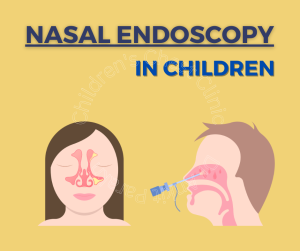
The nasal endoscopy is used for examining the internal structure of the nose. This includes the nasal septum, the nasal turbinates (inferior and the middle turbinates on both the sides), the opening of the sinus is the Eustachian tube opening and the adenoids.
How do you perform a nasal endoscopy?
Nasal endoscopy is performed using a thin flexible tube called a nasal endoscope. The nasal endoscopy has an attached light source which produces illumination and a tiny camera which captures high quality images. The video and the images can be displayed on a computer screen and can also be recorded for future reference. The nasal endoscopes used for nasal endoscopy in children are quite thin, usually of a diameter of 2.7-4 mm.
Nasal endoscopy is a simple OPD procedure which takes around one to 2 minutes to be completed. The nose is first anesthetised by spraying a local anaesthetic spray into both these nostrils. We wait for a period of around 10 minutes for the effect of the anaesthesia to work. Thereafter, the endoscope is gently passed through the nostril to examine the various structures of the nose. The same procedure is then repeated on the other side. Most children are able to tolerate the procedure of nasal endoscopy very well, usually there is no associated pain or bleeding during the procedure.
What information do we get by performing a nasal endoscopy?
Nasal endoscopy can be very useful in diagnosis of many problems. The most common reasons of performing an nasal endoscopy in children could be a child with allergic rhinitis who is not responding to treatment, suspected nasal polyps, a child with chronic cough who is suspected to have chronic sinusitis and examining the adenoids in children who have mouth breathing or snoring.
What are the risks associated with the Nasal endoscopy in children?
Nasal endoscopy is a very safe procedure in children. Most children above the age of 3 or 4 years of age can easily get the procedure done in the OPD setting. Minimum amount of local anaesthesia is required to numb the nose. Occasionally, there can be a small amount of nasal bleed during a nasal endoscopy procedure, which usually stops spontaneously. There is no pain associated with a nasal endoscopy procedure.
Related conditions & services
Medical Advice & Clinical Disclaimer
The educational medical guidance provided in this guide is for informational purposes only. It should not be used as a substitute for direct pediatric consultation, physical diagnosis, or clinical prescription. For individualized medical assessment of your child, schedule an appointment with Dr. Ankit Parakh.

Related articles
 Sep 3, 2026
Cold Urticaria in Children: Symptoms, Causes, Diagnosis and Treatment
Read article
Sep 3, 2026
Cold Urticaria in Children: Symptoms, Causes, Diagnosis and Treatment
Read article
 Sep 10, 2026
My Child’s Urticaria Is Not Getting Controlled: Causes and Treatment Options
Read article
Sep 10, 2026
My Child’s Urticaria Is Not Getting Controlled: Causes and Treatment Options
Read article
 Aug 12, 2026
Oral Food Challenge Test: Milk Challenge for Children with Cow’s Milk Allergy
Read article
Aug 12, 2026
Oral Food Challenge Test: Milk Challenge for Children with Cow’s Milk Allergy
Read article