
On this page 7 sections
Does your child cough through the night, wake up wheezing, or seem to catch a "chest cold" every few weeks? For many families, these flare-ups aren’t just bad luck—they are signs of allergic asthma. In Indian homes, the single most common hidden trigger is the house dust mite.
While daily preventive inhalers are essential to keep your child’s breathing safe, they only control the symptoms while you use them. Today, sublingual immunotherapy (SLIT) offers a way to treat the root cause of the allergy under the tongue—without painful injections.
What Is a House Dust Mite Allergy?
Dust mites are tiny creatures—far too small to see with the naked eye—that live inside our homes. They thrive in warm, humid places and feed on shed human skin flakes. You will find them mostly in:
- Mattresses and pillows
- Blankets and quilts
- Curtains, carpets, and upholstered sofas
- Soft toys
Children are not allergic to the bug itself. Instead, their immune system overreacts to proteins found in the dust mite’s droppings and broken-down fragments. When a sensitive child breathes these in:
- In the nose: It triggers sneezing, a runny nose, and constant blockage (allergic rhinitis).
- In the lungs: It causes swelling in the breathing tubes, chest tightness, persistent coughing, and allergic asthma attacks.
Because dust mites are inside our homes all year long, simply dusting or cleaning more often is never enough to get rid of them completely.
How Does Sublingual Immunotherapy (SLIT) Work?
Think of immunotherapy as teaching your child’s immune system to calm down. Instead of treating just the swollen lungs, sublingual immunotherapy gives your child tiny, controlled amounts of dust mite extract placed under the tongue. The lining under the tongue has special immune cells that absorb the extract safely. Over weeks and months, these cells send "all-clear" signals to the rest of the body. The immune system stops seeing the house dust mite as a dangerous invader and builds natural tolerance.
Benefits and Realistic Expectations
SLIT is a long-term treatment, so having the right expectations from day one is important.
The Benefits
- Fewer Asthma Attacks: Children have fewer sudden flares, especially when changing weather or viral colds come around.
- May Lower Inhaler Doses: As the airways become less sensitive over time, your doctor may be able to step down your child’s daily preventive inhaler doses.
- Treats Both Nose and Chest: It relieves the stuffy, itchy nose and the chest wheezing at the same time.
- No Injections: It is taken by mouth at home, meaning no painful hospital visits for shots.
What It Cannot Do
- It Is Not a Quick Fix: It does not give instant relief like a rescue inhaler. It takes about 2 to 3 months of daily use to see real changes.
- It Requires a 3-Year Commitment: To make the immune system remember this tolerance for years to come, the treatment must be taken every day for 3 years. Stopping too early can cause the allergy to return.
- You Cannot Stop Inhalers Immediately: Never stop your child’s regular inhalers on your own when starting SLIT. Inhalers are only reduced gradually by your child’s doctor once breathing tests and symptoms are clearly improved.
- It Only Works for True Dust Mite Allergies: It will not help asthma triggered purely by cold weather, viral infections, or air pollution unless a house dust mite allergy is also present.
Standardized Tablets vs. Allergy Drops
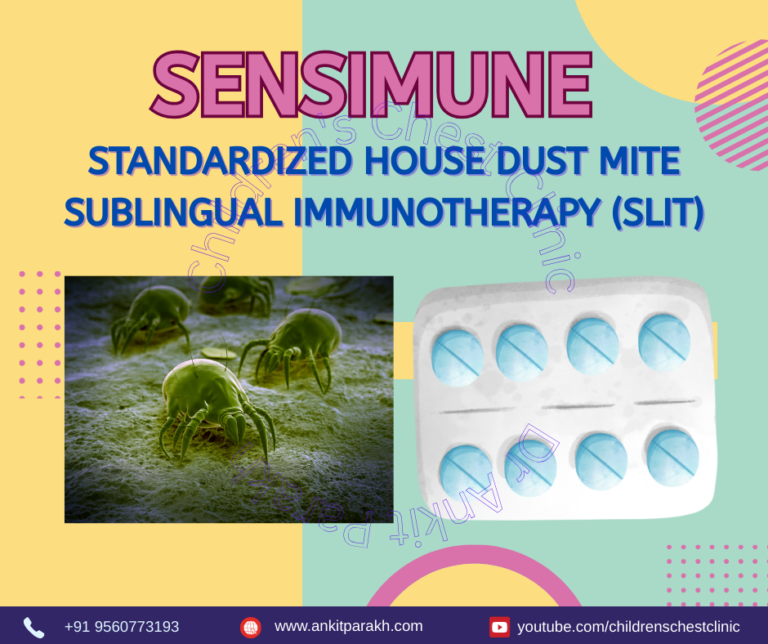
In India, sublingual immunotherapy has traditionally been given as liquid drops counted out from a small bottle under the tongue. Drops have helped many children, but they require careful counting, proper bottle handling, and often refrigeration. Families now also have access to modern, standardized allergy tablets (such as Sensimune or Acarizax):
| Feature | Standardized Tablets (Sensimune, Acarizax) | Allergy Drops (Liquid) |
|---|---|---|
| Dosing Accuracy | Exactly the same measured dose in every single tablet | Relies on counting drops manually each morning |
| How It Is Taken | Tiny tablet placed under the tongue; melts in a few seconds | Liquid squirted under the tongue; held for 1–2 minutes |
| Scientific Evidence | Backed by large global clinical trials specifically for allergic asthma | Varies depending on the manufacturer and mixing center |
| Storage & Travel | Keeps safely at room temperature in simple blister packs | Often requires refrigeration to stay stable |
While liquid drops are still an option, these standardized tablets make treatment simpler, more reliable, and easier to keep up with on busy school mornings or during family trips.
What Does the Treatment Routine Look Like?
- Allergy Testing First: Your child’s pulmonologist or allergy specialist will run a simple Skin Prick Test or an allergy blood test (specific IgE) to confirm that the house dust mite is truly triggering their asthma.
- First Dose at the Clinic: The very first dose is always given at the doctor’s office, where the child is watched for 30 minutes to make sure they tolerate it comfortably.
- Daily Routine at Home: Each morning, place the tablet under your child’s tongue with dry fingers. It melts within seconds. Your child should wait 1 minute before swallowing saliva, and avoid eating or drinking for 5 minutes after.
- Mild Side Effects: It is completely normal for children to feel mild itching under the tongue or a slight tickle in the throat during the first couple of weeks. This is a sign the local immune cells are working, and it usually fades away on its own.
Conclusion
Managing your child’s allergic asthma doesn’t have to mean endlessly reacting to sudden nighttime coughing fits or unpredictable wheezing episodes. While inhalers remain vital for day-to-day safety, sublingual immunotherapy gives families a proven, needle-free way to address the root allergy itself. With modern, standardized sublingual tablets like Sensimune and Acarizax now readily available alongside established drops, helping your child build natural, long-lasting tolerance to the house dust mite is simpler and more reliable than ever. If your child’s asthma flares up indoors or lingers despite regular medications, consult your pediatric pulmonologist or allergy specialist to see if immunotherapy is the right step toward clearer breathing and peaceful nights.
Frequently Asked Questions (FAQs)
1. Can we stop our child’s inhaler once we start sublingual immunotherapy?
No. Never stop your child’s regular inhalers on your own. Immunotherapy works slowly in the background to retrain the immune system. Keep using all prescribed inhalers normally. Over several months, as your child’s lungs become less reactive to the house dust mite, your doctor will guide you on how to safely reduce inhaler doses.
2. Is it safe to give SLIT if my child is currently wheezing?
No. Immunotherapy should only be given when your child’s asthma is calm and well-controlled. If your child is having an active coughing flare-up, wheezing, or an acute chest infection, hold off on the daily dose and contact your doctor for advice.
3. How soon will we see an improvement in our child’s asthma?
Most parents begin noticing fewer night awakenings, less morning coughing, and reduced need for rescue inhalers after 8 to 14 weeks of daily use. However, completing the full 3-year course is necessary to make this protection last long after the tablets are stopped.
4. What should we do if we forget a dose?
If you miss a day, simply give the regular single tablet the next morning at the usual time. Never give two tablets to make up for a missed day. If you miss doses for more than a few days in a row, check with your clinic before restarting.
5. Why choose tablets like Sensimune or Acarizax instead of drops?
Standardized tablets like Sensimune and Acarizax remove the guesswork of counting liquid drops. Every tablet provides the exact same scientifically proven dose of house dust mite proteins, dissolves in seconds, doesn’t need to be kept in the fridge, and has been extensively tested in clinical trials to reduce asthma attacks in children.
Related conditions & services
Medical Advice & Clinical Disclaimer
The educational medical guidance provided in this guide is for informational purposes only. It should not be used as a substitute for direct pediatric consultation, physical diagnosis, or clinical prescription. For individualized medical assessment of your child, schedule an appointment with Dr. Ankit Parakh.

Related articles
 Sep 15, 2025
SENSIMUNE or ACARIZAX: Standardised Dust Mite Immunotherapy
Read article
 Sep 18, 2023
Sublingual Immunotherapy (SLIT) for Allergic Rhinitis or Nasal Allergy in Children!
Read article
 Oct 2, 2026
Bermuda Grass or दूब (Doob) Grass Allergy in Children: Symptoms, Diagnosis and Treatment
Read article